
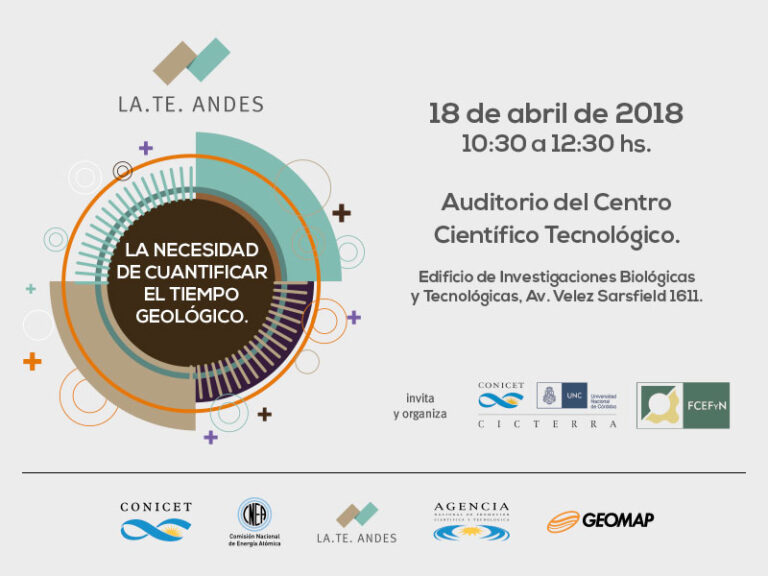
THE NEED TO QUANTIFY GEOLOGICAL TIME. This is the title of the talk to be presented by the LA.TE. ANDES Project—a CONICET initiative—on April 18, 2018, at 10:30 a.m. in the Auditorium of the Scientific and Technological Center at the National University of Córdoba, located in the Biological and Technological Research Building at 1611 Velez Sarsfield Avenue.
The methodological approaches for data generation and interpretation will be presented:
Thermocronology at low temperatures and U-Pb geochronology. In situ double dating. “A novel combination of methodological tools to establish the history of exhumation/burial, thermal history, and absolute crystallization age (rock age, maximum sedimentation age, provenance)”
A) Multiple dating: fission track dating in Ap and Zr. (U-Th-Sm)/He ages in Ap and Zr. Low temperature (280–40°C).
B) High-temperature geochronology (900–750°C): U/Pb in zircons. (LA-ICP-MS, triple quadrupole, QQQ).
Paleomagnetism with high resolution and sensitivity in Argentina using the Argentine cryogenic magnetometer Cri.Ar (nationally developed and manufactured under a collaborative agreement between LA. TE. ANDES S.A. – ENDEAVOUR INGENIERÍA S.R.L. – CNEA – CONICET) “A method for dating and understanding the rates of structural formation in a folded and thrust belt. Development of a new dating methodology for the Paleozoic of the Tarija Basin.”
Andino 3D® is structural modeling software developed by LA.TE. ANDES S.A. for the integration of geological and geophysical information, which enables the handling of digital topographies, raster images, 2D and 3D seismic data, well information, vectorized maps, and surface and subsurface structural information combined with kinematic and thermokinetic models for the creation and interpretation of structural models. Including the ability to integrate exhumation time and thermal history data, generated at the Center itself.
“The three productive pillars will enable the generation of TIME data, considered fundamental to addressing a major need and gap in earth sciences, the hydrocarbons industry, and conventional and alternative mineral and energy resources.”