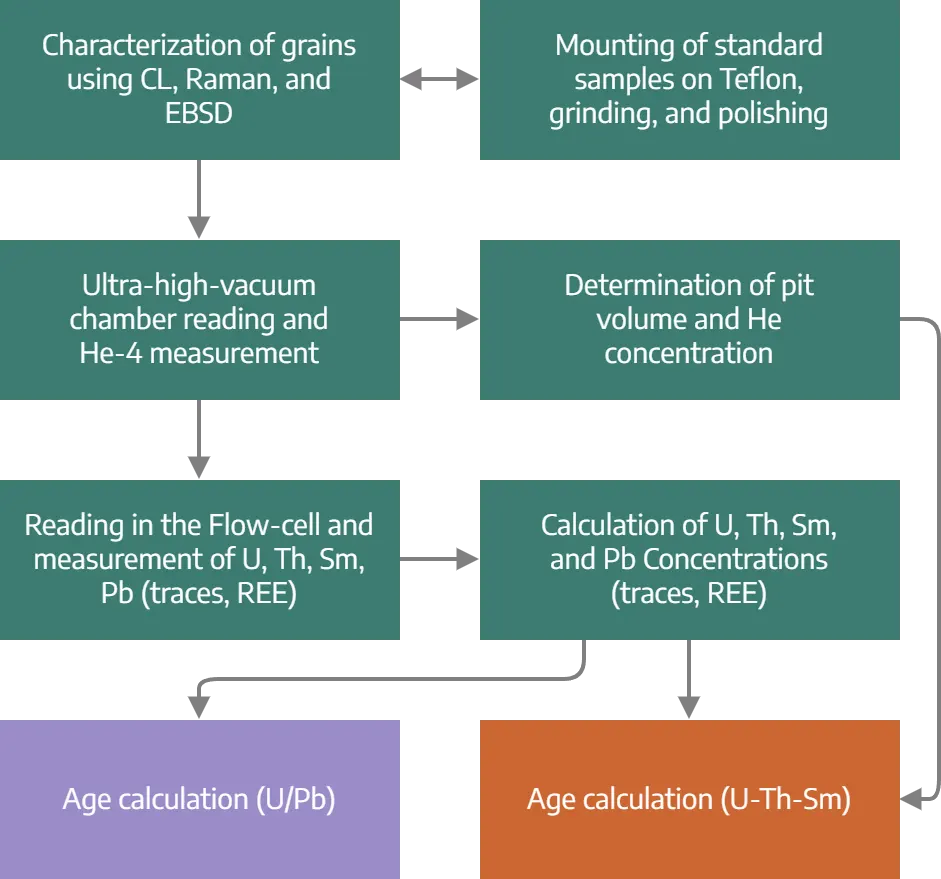
Cron.Ar combines (U-Th-Sm)/He thermochronology and U/Pb geochronology in a dual-dating system that covers a wide range of temperatures (850°C to 40°C), accurately reconstructing thermal histories.
We have in-house professionals trained in these techniques and share our knowledge with the academic community.
The information we provide reduces exploration risk in the hydrocarbon and mining sectors and offers an innovative tool for regional geothermal exploration.
Productive process In situ double dating using (U-Th)/He and U/Pb age determinations
Methodological integration
Methodological integration
By extending the thermal measurement window to 40°C and the dating limit to younger ages with greater precision, we can determine the formation of mountain ranges and associated basins linked to cycles of high exhumation-burial rates with ages younger than 10 Ma. Furthermore, the results obtained using this method can be combined with data from fission-track analyses, thereby precisely determining the time-temperature history of a rock sample.
Features and benefits
01 (U-Th-Sm)/He and U/Pb Double dating
In addition to the thermocronology services we already offer, we have added the capability to perform (U-Th-Sm)/He dating, thereby improving the accuracy and expanding the temperature range of the data obtained. Combined with U/Pb dating and our dual-dating system, this capability has direct applications in the oil &gas industry.
02 Expert technical team
We also have our own professionals trained in (U-Th-Sm)/He thermochronology and U-Pb geochronology techniques, which are strategically important technologies worldwide for the oil, gas and mining industries, as well as for scientific research.
03 Knowledge transfer
We transfer the knowledge and skills we have acquired in the industrial and academic spheres to universities and research centers.
04 Reconstruction of thermal histories
We use thermocronometers and geocronometers in combination and simultaneously (dual dating), which allows us to determine thermal histories over a wide range of temperatures (850°C to 40°C).
05 Exploratory risk mitigation in the oil & gas sector
We reduce the exploratory risk associated with hydrocarbons by determining the maximum temperatures reached by the organic matter present in source rocks, the ages of generation and the chronology of structural trap development in conventional targets and burial sites, the generation and accumulation of hydrocarbons in unconventional targets, the sedimentation ages of guide layers (pyroclastic), and the ages of maximum sedimentation and provenance.
06 Exploratory risk mitigation in mining
We reduce the exploratory risk associated with mineral resources by determining the ages of magmatic bodies associated with disseminated mineralization; the ages of hydrothermal alteration processes; the age and duration of mineralization processes; rates of exhumation and erosion, and the degree of preservation of primary mineralization; the potential for supergene/exotic (post-mineralization) enrichment; the ages of base-metal vein mineralization; and the identification of potential areas with buried intrusions.
07 Regional geothermal exploration
We offer an innovative tool for regional-scale geothermal exploration that makes it possible to identify potential hidden geothermal resources; define zones of hydrothermal fluid migration and estimate their temperature; calculate heat fluxes in a region with geothermal potential; and identify advection zones and complex structural zones with the potential for tectonically induced permeability increases.