
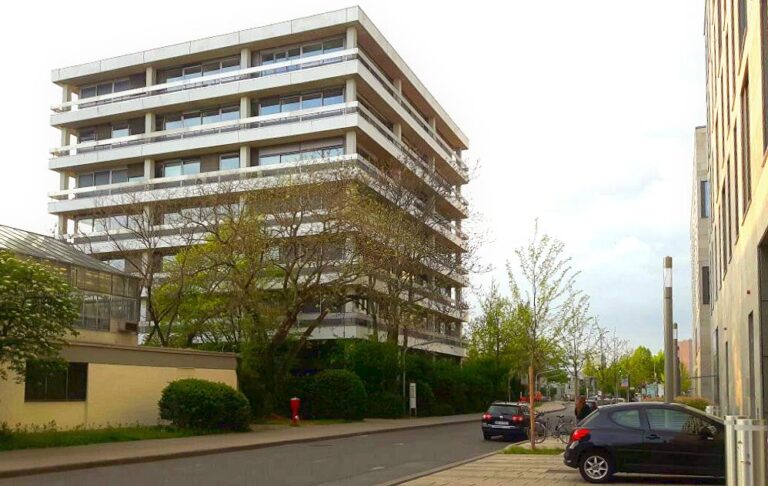
Between March 1 and May 5, 2017, members of LaTe Andes completed the second phase of training at the Laboratory of Thermochronology and Archaeometry at Heidelberg University in Germany.
During this stay, they worked on various procedures related to fission track and (U-Th-Sm)/He methods in apatites and zircons, allowing them to expand and refine skills to be applied at the LaTe Andes Laboratory in Salta.
The tasks carried out consisted of four main groups:
Refinement of track counting, measurement of confined track lengths, Dpar, and age calculation, including samples from the Argentine and Bolivian Sub-Andean system.
Fission track counting using optical microscopy and the Austoscan® program, refining the differentiation between spontaneous tracks and dislocations in apatites. Determination of central ages using the Trackkey® software, distinguishing different populations of individual ages in order to characterize geological processes of heating/subsidence and cooling/exhumation.
Preparation of samples for fission track dating in zircons, measurement of dosimetric glasses and standard samples, and calculation of the calibration value Z.
Mounting (preparation of Teflon discs), polishing, chemical etching, and subsequent visualization of spontaneous traces and assessment of etching quality for fission track dating procedures. Using previously prepared samples, training began on the measurement of dosimetric glasses and standards (Fish Canyon Tuff) for the calculation of the calibration value Z.
Sample preparation and determination of correction factors for the (U-Th-Sm)/He method in apatites.
Observation of apatites and zircons under a binocular magnifying glass, photographic recording of individual grains, and measurement of their dimensions for the correction of diffusion parameters of the (U-Th-Sm)/He system. Packing of individual grains into niobium (Nb) tubes for dating procedures.
Training in Numerical Modeling.
Numerical modeling of thermochronological data (dataset) in conjunction with the stratigraphic context inherent to each sample, with the aim of determining their thermal evolution based on the definition of time-temperature trajectories. Numerical modeling was performed using the HeFTy® software on surface samples from the Argentine-Bolivian Sub-Andes, characterized as a compressional system with high rates of subsidence/exhumation, and on borehole samples from the Aachen region, located between the Variscan folded and faulted belt and the Rhine Graben in Germany.
In addition, observations were made using SIMS (Secondary Ion Mass Spectrometry), high-tech equipment at the University of Heidelberg, used for the absolute determination of ages with high precision.