
Por Ingrid Lucero Parada. Fuente: Noticias Institucionales de CONICET
Paleomagnetism is the study of the Earth’s magnetic field as recorded by rocks at the time of their formation or during significant geological processes that occurred later. The ability to measure it is vital to the oil industry, as it provides key information about oil formation and the geological traps that contain it, thereby reducing investment risks.
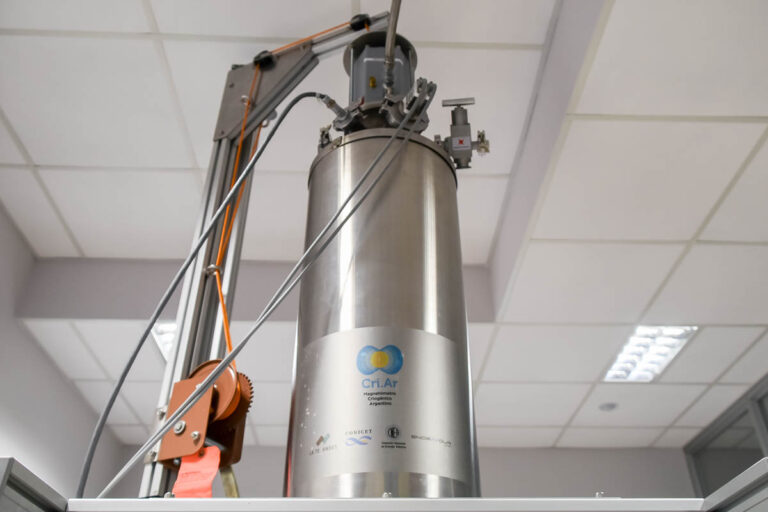
The equipment capable of doing this is called a cryogenic magnetometer, and until now, the only manufacturer in the world was located in California, United States. However, a cutting-edge Argentine technological development led by the company La. Te Andes in conjunction with the National Scientific and Technical Research Council (CONICET), the National Atomic Energy Commission (CNEA), and the company Endeavour Ingeniería, has made it possible for our country to have the second piece of equipment in the world capable of measuring the paleomagnetism of rocks using superconducting sensors.
“The cryogenic magnetometer is an instrument that allows us to determine what the magnetic field was like when the rock formed—that is, where the North Pole or South Pole was at the time the rock was formed. It features cutting-edge technology and highly sophisticated electronics,” explains Roberto Hernández, President of La.Te Andes.
He adds: “The Cri.Ar project makes us the second facility in the world to produce this type of technology and will allow us to establish a high-speed service structure thanks to the level of automation achieved. The equipment processes a sample every three minutes, meaning the analysis throughput meets the demands of the oil industry.”
In fact, Cri.Ar—which is already operational—has capabilities similar to or superior to those of commercial magnetometers, at a fraction of the cost. In technical terms, the equipment allows for the collection of information regarding deformation timing, crown orientation, quantification of rotations, chronostratigraphic location of sedimentary profiles, sedimentation rates, determination of petrofabric, and paleocurrent orientation.
CONICET researchers based at the CNEA—Julio Guimpel, Mariano Gomez Berisso, Víctor Correa, Pablo Pedrazini, and Marcelo Vasquez Mansilla—were part of the team that developed this innovation. Conceptualizing the design, programming structural geological modeling software, and defining the mechanics and electronics are just some of the issues they had to resolve together with staff from La.Te Andes and Endeavour Ingeniería.
Principal investigator Julio Guimpel, the project director, comments: “It’s always a challenge to tackle the design of new equipment. In this case, the added challenge was that it was needed by a company engaged in exploration, which in turn meant developing something that would be productive for the country—that was very motivating.”
“We produce knowledge, but it’s also necessary to leverage that knowledge in the provision of services or technological goods. In this case, it is a unique niche because there are no companies doing the same thing; it is a device that is not available on the market,” adds Gomez Berisso, an independent researcher at the CNEA’s Low-Temperature Laboratory, who was specifically involved in the mechanical and cryogenic aspects of the equipment.
The Complementarity of Disciplines and Resources as a Strategy
Having a cryogenic magnetometer in our country is the result of synergy between companies committed to driving industry growth through innovation, and the support of scientific institutions such as CONICET and the CNEA, which promote the country’s technological advancement, the development of the national economy, and the improvement of quality of life.
“The CRI.AR project was a year-long process, thanks to more than fifty years of scientific development in these areas in our country. We found an opportunity in the industry and the capabilities to tackle it jointly with the national scientific system,” says the president of La.Te Andes.
“In this highly complex project, complementarity was key, as was forming interdisciplinary teams capable of managing diverse areas of expertise,” adds Nicolás Hernández, managing partner at Endeavour Ingeniería, who served as the project’s general coordinator.
“Argentina has enormous scientific and technological potential and capabilities that set it apart from other countries. We just need to harness it. This project is an attempt to do just that,” he adds.
A company born of a public-private partnership
La.Te Andes is a technology-based public-private joint venture located in the province of Salta, comprising the company GEOMAP S.A. (51%) and CONICET (49%). It also collaborates with other institutions within the national scientific and technological system and abroad.
Since its inception, the company has established itself as a productive technological hub for innovation in applied energy and scientific development, seeking to quantify the time variable—which is fundamental to the economic impact of hydrocarbon projects, among others—during both the exploration and development stages. Among its objectives are the development and implementation of technology-based strategic projects aimed at resolving sensitive issues in the valuation of georesources (hydrocarbons, mineral deposits, geothermal energy, among others).
CRI.AR Work Team:
Roberto Hernandez, B.S. (LaTe Andes)
Nicolás Hernandez, M.S. (LaTe Andes – Endeavour Ingeniería)
Ernesto Cristallini, Ph.D. (LaTe Andes)
Ezequiel Justiniano, M.S. (Endeavour Ingeniería)
José Piracés, B.S. (Endeavour Ingeniería)
Julio Guimpel, Ph.D. (Low Temperature Physics Division, CNEA-CONICET)
Mariano Gomez Berisso, Ph.D. (Low Temperature Physics Division, CNEA-CONICET)
Dr. Correa, Victor BT (Low Temperature Physics Division, CNEA-CONICET)
Dr. Luzuriaga, Javier (Low Temperature Physics Division, CNEA)
Dr. Pedrazini, Pablo (Low Temperature Physics Division, CNEA-CONICET)
Dr. Vasquez Mansilla, Marcelo (Magnetic Resonance, CNEA-CONICET)
Artola Vinciguerra, Ignacio (Low Temperature Physics Division, CNEA)
Fuentes, Rodolfo (Low Temperature Physics Division, CNEA)
Hansen, Santiago (Low Temperature Physics Division, CNEA)