
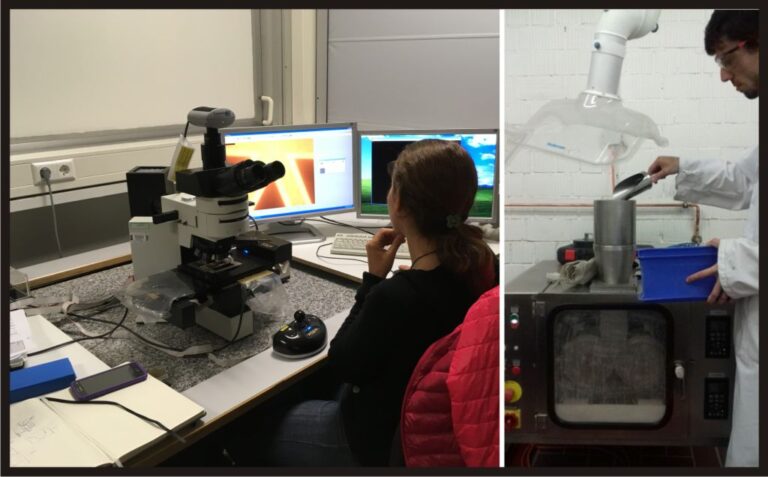
Between April 4 and July 19, members of LaTe Andes participated in a training program at the Thermochronology Laboratory at Heidelberg University in Germany.
During the program, they worked on various techniques related to the analysis of fission traces. The goal was to advance their understanding of the methodology and techniques so they could be applied at the LaTe Andes Laboratory in Salta.
The tasks carried out fell into two main categories:
A. Sample preparation
B. Identification, measurement of traces and lengths, and age calculation.
A: Separation of heavy minerals, particularly apatites and zircons: through grinding, sieving, dense liquids, magnetic separator, and hand picking. Packaging and unpacking of samples. Acid etching of apatite, zircon, and mica samples to visualize both spontaneous and induced fission tracks.
B: Identification and counting of fission tracks using optical microscopy and the AutoScan software. Dating of fission tracks: counting and determination of the central age using the TrackKey software. D-Par measurement: this involves measuring the etch pits of fission tracks to assess the chlorine/fluorine ratio of the apatite. Measurement of confined track lengths.
In addition, a visit was made to the Mark II facility in Mainz (http://www.kernchemie.uni-mainz.de/eng/234.php) to learn about the necessary irradiation conditions, and to the Institute of Petroleum Geology and Geochemistry at the University of Aachen to review vitrinite study methodology.
Currently, the knowledge acquired is being applied locally at LaTe Andes, specifically to the initial stage of sample preparation, as the necessary equipment is now in place.